Types of pigmentation in Singapore, explained
A neutral guide to freckles, sunspots, melasma and post-inflammatory marks: how they differ, why diagnosis matters, and what treatment discussions may involve.
“Pigmentation” is an umbrella word for several different conditions that happen to share a symptom — darker patches on the skin. In Singapore’s sunny, humid climate they are extremely common. The reason it is worth telling them apart is practical: the type determines the treatment, and the wrong approach can make some kinds worse. This is general information for your research only — not medical advice, and not a diagnosis.
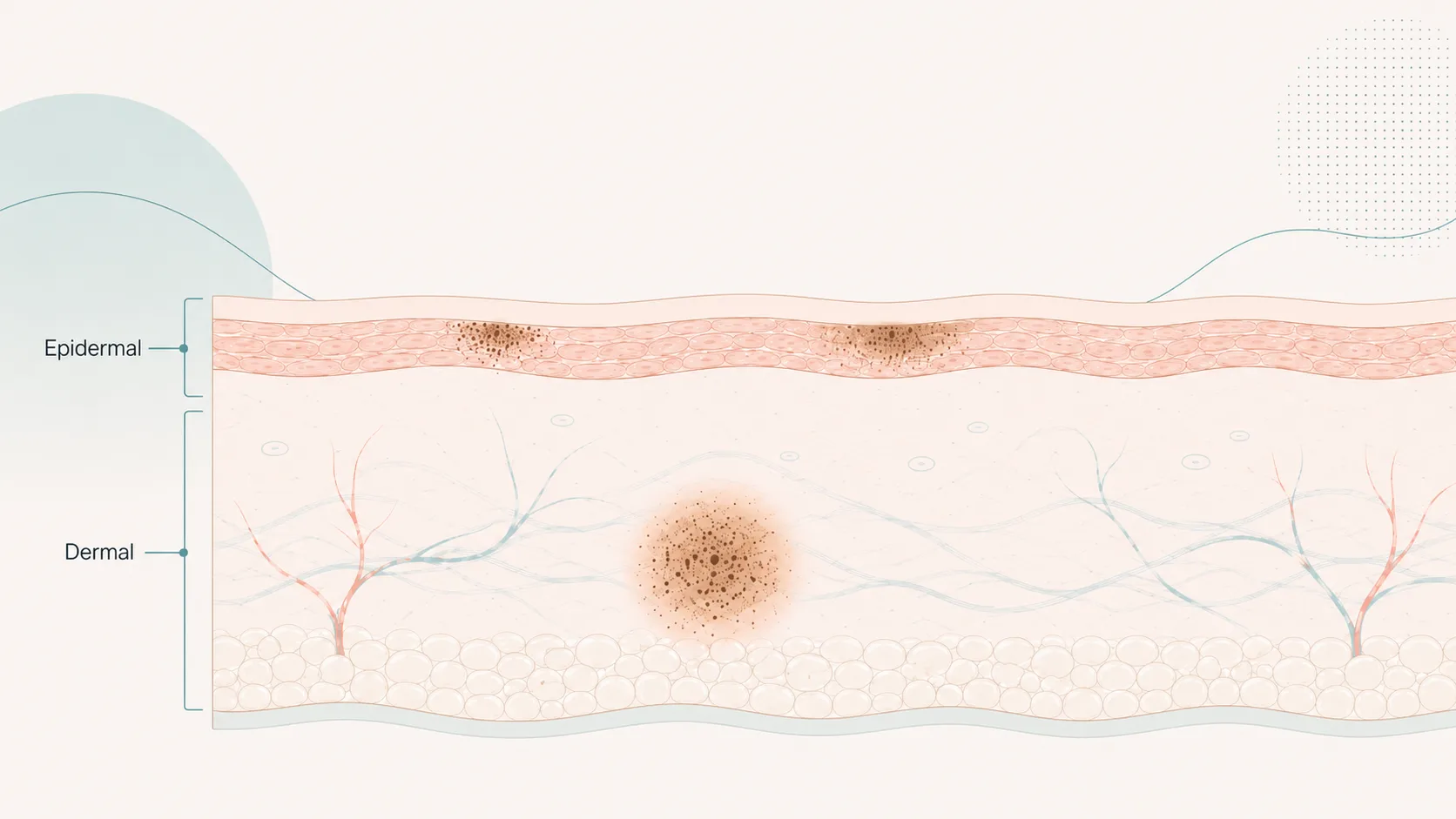
Why depth matters: epidermal vs dermal
Pigment can sit at different depths. Epidermal pigmentation is nearer the surface; dermal pigmentation sits deeper; and some conditions are mixed. Depth is one of the things that affects how — and whether — a condition can be treated, which is part of why a trained eye (sometimes with special lighting) is used to assess it rather than guessing from a photo.
Freckles (ephelides)
Small, flat, light-brown spots that tend to appear with sun exposure and often run in families. They usually darken in the sun and can fade when sun exposure drops.
Sunspots and age spots (solar lentigines)
Larger, more defined flat brown patches that build up from cumulative sun exposure over the years, often on the face and the backs of the hands. They do not fade the way freckles do.
Melasma — the tricky one
Melasma shows up as larger, patchy, often symmetrical pigmentation, commonly on the cheeks, forehead or upper lip. It is linked to hormones, heat and light, which makes it stubborn and easily aggravated. Dermatology centres, including the National Skin Centre, describe the usual first step as topical treatment and diligent sun protection, with procedures considered only in selected cases — and note that the wrong or overly aggressive treatment can make melasma worse. If there is one type where a careful diagnosis before any laser really matters, it is this one.
Post-inflammatory hyperpigmentation (PIH)
Flat brown or grey-brown marks left after inflammation — most often acne, but also injury or irritation. It is very common in Asian and darker skin, and often improves gradually with sun protection and time, sometimes helped by topical treatment.
Post-inflammatory erythema (PIE)
Flat red or pink marks, also left after acne or inflammation. Although it is grouped with “acne marks”, PIE is vascular (related to blood vessels) rather than pigment — which is why it is approached differently from the brown marks of PIH.
Dermal pigmentation
Some pigmentation sits deeper in the skin — conditions such as Hori’s nevus (acquired dermal melanocytosis) or nevus of Ota. Because of their depth and nature, these are assessed and managed specifically, and are not something to self-diagnose.
Why diagnosis comes first
Several of these look alike to the untrained eye but respond to completely different treatment — and, as with melasma, an approach that suits one type can aggravate another. That is why the sensible first step is an assessment by a doctor or dermatologist, not a treatment chosen from the name of a laser. Sometimes the most valuable outcome of that assessment is being told that a gentle, non-procedural approach is the right starting point.
How pigmentation is generally approached
Two things are near-universal: sun protection, which underpins almost all pigmentation care in Singapore’s climate, and patience, since many types improve gradually. Beyond that, topical treatments and — selectively, and only when appropriate — procedures may be discussed. For the treatment side in more detail, see our guide to pigmentation treatment options and the pigmentation overview; for one specific device, see the Pico laser guide.
A note on regulation
Aesthetic lasers and energy devices are regulated as medical devices by the Health Sciences Authority and should be used under a registered medical practitioner. If a treatment is being recommended for your pigmentation, it is reasonable to confirm the doctor is SMC-registered and the clinic is HCSA-licensed — see how we verify.
Questions to ask before treatment
- What type (or types) of pigmentation do I actually have, and at what depth?
- Is a procedure the right first step, or should topical treatment and sun protection come first?
- If it is melasma, how will you avoid making it worse?
- Is the treating doctor SMC-registered and the clinic HCSA-licensed?
- What results are realistic, and how many sessions and what total cost are likely?
Common questions
Can I tell my pigmentation type myself? Often not reliably — several types look similar, and depth is hard to judge by eye. A proper assessment is what distinguishes them.
Is laser the answer for all pigmentation? No. Some types respond to laser, some are better managed with topical treatment and sun protection first, and some (such as melasma) can worsen with the wrong approach.
Why does my pigmentation keep coming back? Sun exposure, heat and, for melasma, hormones can all drive it, which is why sun protection and realistic, ongoing management matter. Discuss maintenance with your doctor.
For the treatment side, see pigmentation treatment options; for the concern overview, see pigmentation.