HIFU vs threadlifts in Singapore: how they differ
A neutral comparison of HIFU and thread lifts for the lower face: how they work, downtime, possible duration, risks and assessment considerations.
HIFU and thread lifts are both marketed as non-surgical ways to firm or lift the lower face, so they are often weighed against each other. But they work in fundamentally different ways, with different downtime, risks and trade-offs. This guide compares them neutrally — it is general information for your research only, not medical advice, and does not rank one above the other.
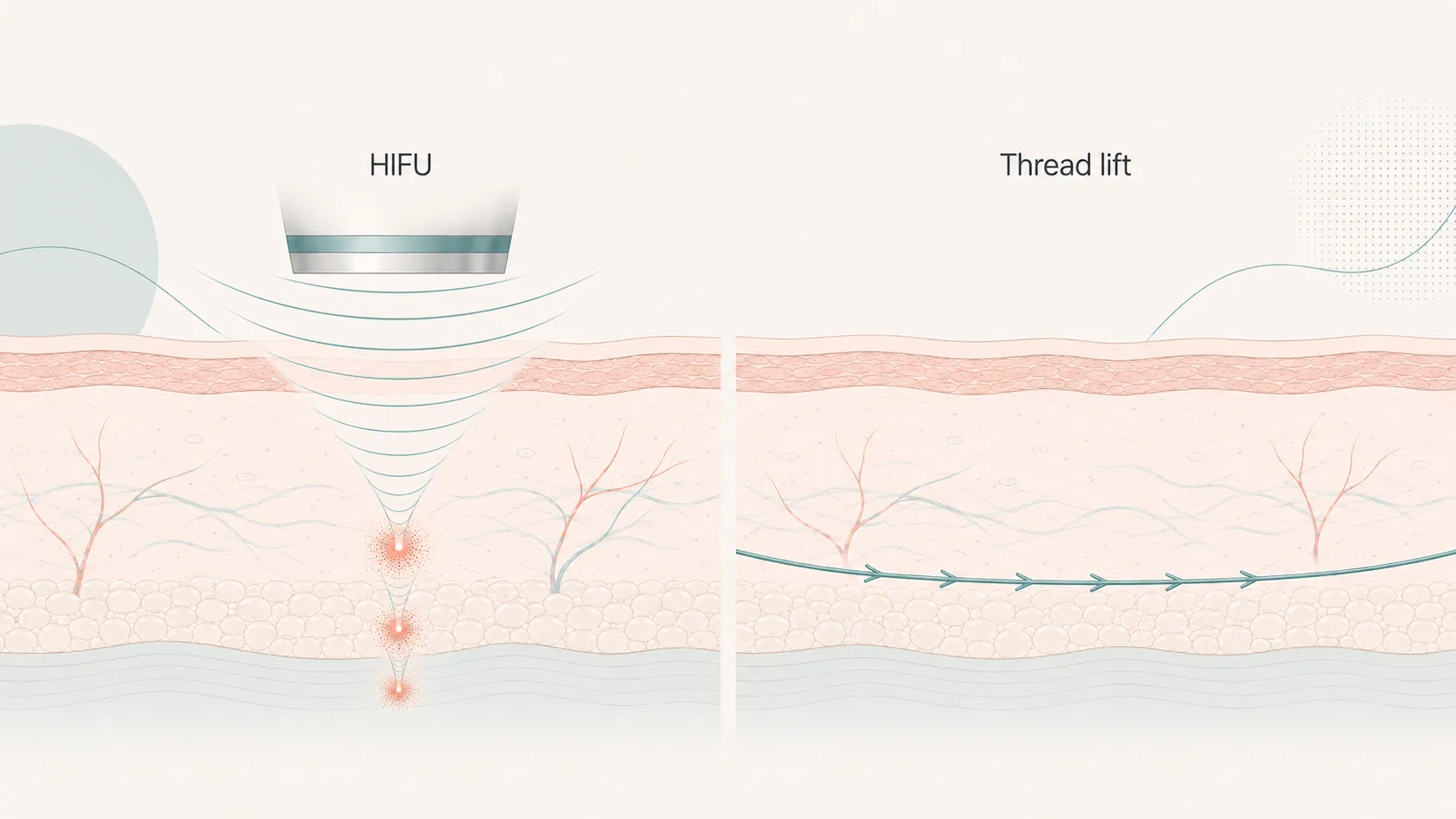
What each one is
- HIFU (high-intensity focused ultrasound) delivers focused ultrasound energy to points at set depths below the skin, creating tiny zones of heating that prompt the body’s collagen-remodelling response over the following weeks. Nothing is placed in the skin.
- A thread lift uses fine absorbable sutures (commonly made of materials such as PDO, PLLA or PCL) inserted under the skin. The threads provide a degree of mechanical repositioning and, as they dissolve over months, are also intended to stimulate collagen along their path.
The core difference is simple: HIFU is energy, a thread lift is a physical thread.
How the effect develops
- Thread lifts can produce some immediate mechanical effect from the repositioning, with any collagen-related change developing afterwards.
- HIFU works gradually, as collagen remodels over weeks to months; there is no repositioning on the day.
Neither is surgery, and for both the effect is a degree of firming or lifting in suitable candidates — not a surgical result. Outcomes vary between individuals and cannot be promised.
Downtime
- HIFU commonly involves little visible downtime, though temporary redness, mild swelling or tenderness can occur.
- Thread lifts are more invasive and typically involve more downtime — swelling and bruising are common, and clinics often advise temporary restrictions (for example on certain facial movements or sleeping positions) while healing.
How long effects may last
Both are temporary, and skin continues to age. Threads absorb over months, and any collagen-related effect is discussed in that context; HIFU’s effect is likewise not fixed in duration. Realistic longevity and any maintenance are things to discuss with your doctor rather than a number anyone can state for everyone.
Risks and side effects
Different mechanisms carry different risks:
- HIFU — redness, swelling, tenderness, temporary altered sensation or numbness, and rarely burns or temporary muscle weakness if energy is misdirected.
- Thread lifts — bruising, swelling, infection, thread migration or extrusion, dimpling or puckering, asymmetry, or the thread being felt under the skin.
For both, the skill and anatomical knowledge of the treating doctor is central to safety.
Which might suit whom
This is a medical judgement, not a rule of thumb. In general terms, the two are sometimes considered for different situations, and are occasionally combined as part of a plan — but for more advanced skin laxity, a doctor may advise that neither is likely to do much and that surgical options are worth discussing. The honest, useful answer comes from an assessment of your face and goals.
Not a substitute for surgery
Neither HIFU nor thread lifts remove or surgically reposition tissue the way a facelift does. If your goal is a change that these non-surgical options realistically cannot deliver, a good clinic will tell you so rather than sell you repeat sessions.
How they are regulated in Singapore
Both are medical procedures that should be performed under a registered medical practitioner in an appropriately licensed clinic; HIFU devices are regulated as medical devices by the Health Sciences Authority. The Singapore Medical Council’s guidelines classify aesthetic procedures by the strength of the evidence behind them. Confirm an SMC-registered doctor and an HCSA-licensed clinic before booking — see how we verify and the clinic directory.
What they cost
Both are usually priced by the area and the amount of treatment (energy lines or shots for HIFU; the number and type of threads for a thread lift), so quotes vary widely. General ranges are on our price guide, and our guide to how aesthetic pricing works explains how to read a quote.
Questions to ask before booking
- For my face and goals, is HIFU, a thread lift, a combination, or neither the more appropriate option?
- Is the treating doctor SMC-registered and the clinic HCSA-licensed?
- What results are realistic for me, over what timeframe, and how long might they last?
- What are the specific risks and the downtime for the option you’re recommending?
- What is the total expected cost, including any repeat or maintenance treatment?
Common questions
Which lasts longer, HIFU or threads? Both are temporary and neither has a fixed duration that applies to everyone; longevity depends on the individual and should be discussed with your doctor.
Is a thread lift the same as a facelift? No. A thread lift is non-surgical and does not remove or surgically reposition tissue. Its effect and durability differ from surgery.
Can I have both? They are sometimes combined as part of a plan, but whether that is appropriate for you is a decision for a doctor.
For how HIFU works in detail, see the HIFU guide and how HIFU compares with Ultherapy and Thermage.