HIFU in Singapore: what it treats, what to expect, and how to choose
A neutral guide to HIFU for skin lifting: how it works, common uses, risks, comparisons with other options, and what to check before booking in Singapore.
HIFU is one of the most common non-surgical “lifting” treatments offered in Singapore, and expectations around it are often set by marketing rather than by how the technology actually works. This guide explains what high-intensity focused ultrasound does, what it can and cannot realistically achieve, what a session involves, and how it compares with the other names you will hear. It is general information for your research only — not medical advice, and not a quote. Whether it suits you is a decision for a doctor.
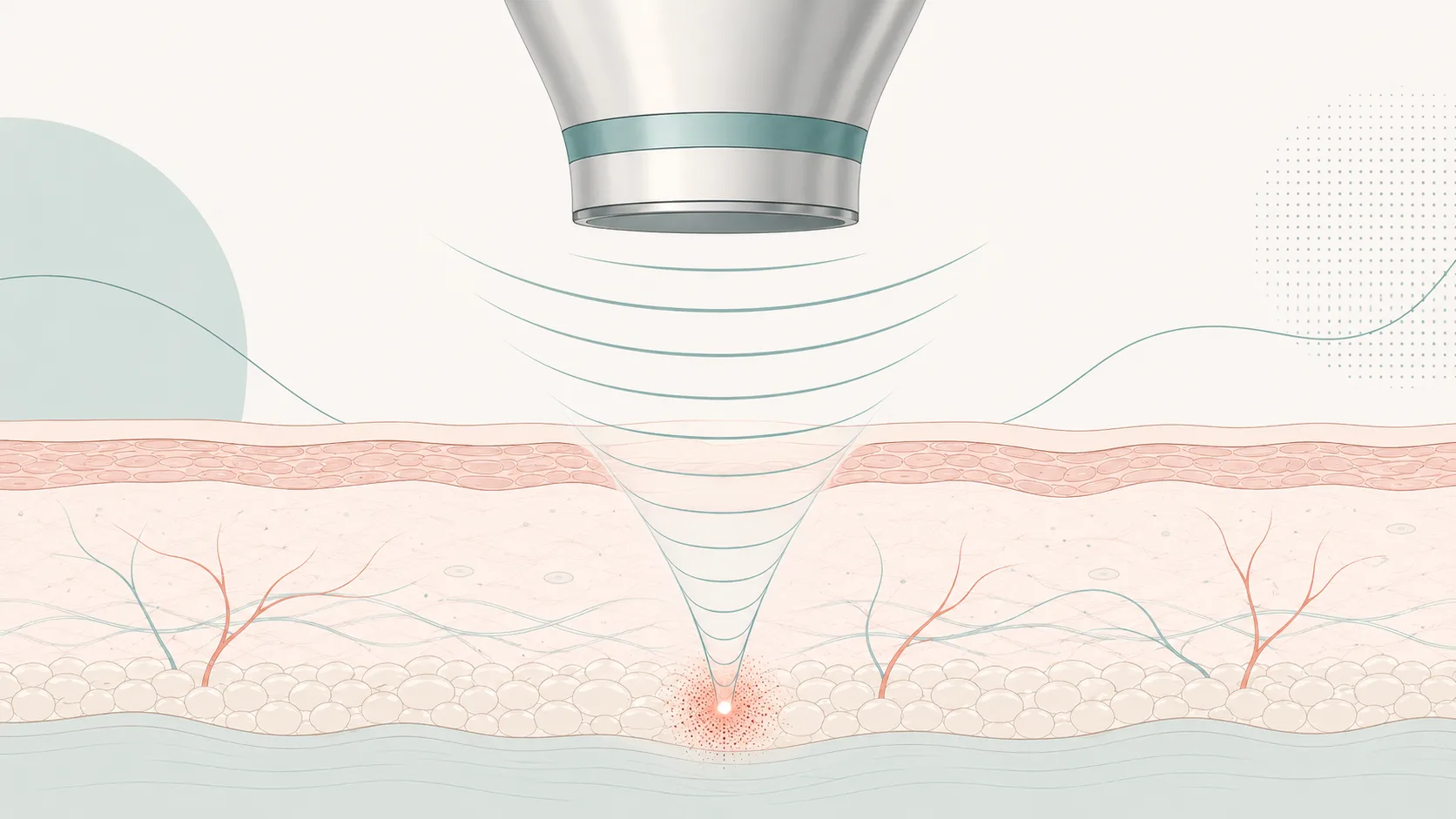
What HIFU actually does
HIFU stands for high-intensity focused ultrasound. Instead of acting on the skin’s surface, the device focuses ultrasound energy to small points at set depths below the surface, where it creates tiny zones of controlled heating. The idea is that these points prompt the body’s natural wound-healing and collagen-remodelling response over the following weeks, which can support gradual firming and lifting.
Two things follow from this mechanism, and they matter for expectations:
- The effect is gradual, not immediate — collagen remodelling happens over weeks to months, not on the day.
- It works on the skin and the tissue layer beneath it. It is not surgery, and it does not remove skin or fat the way a surgical procedure would.
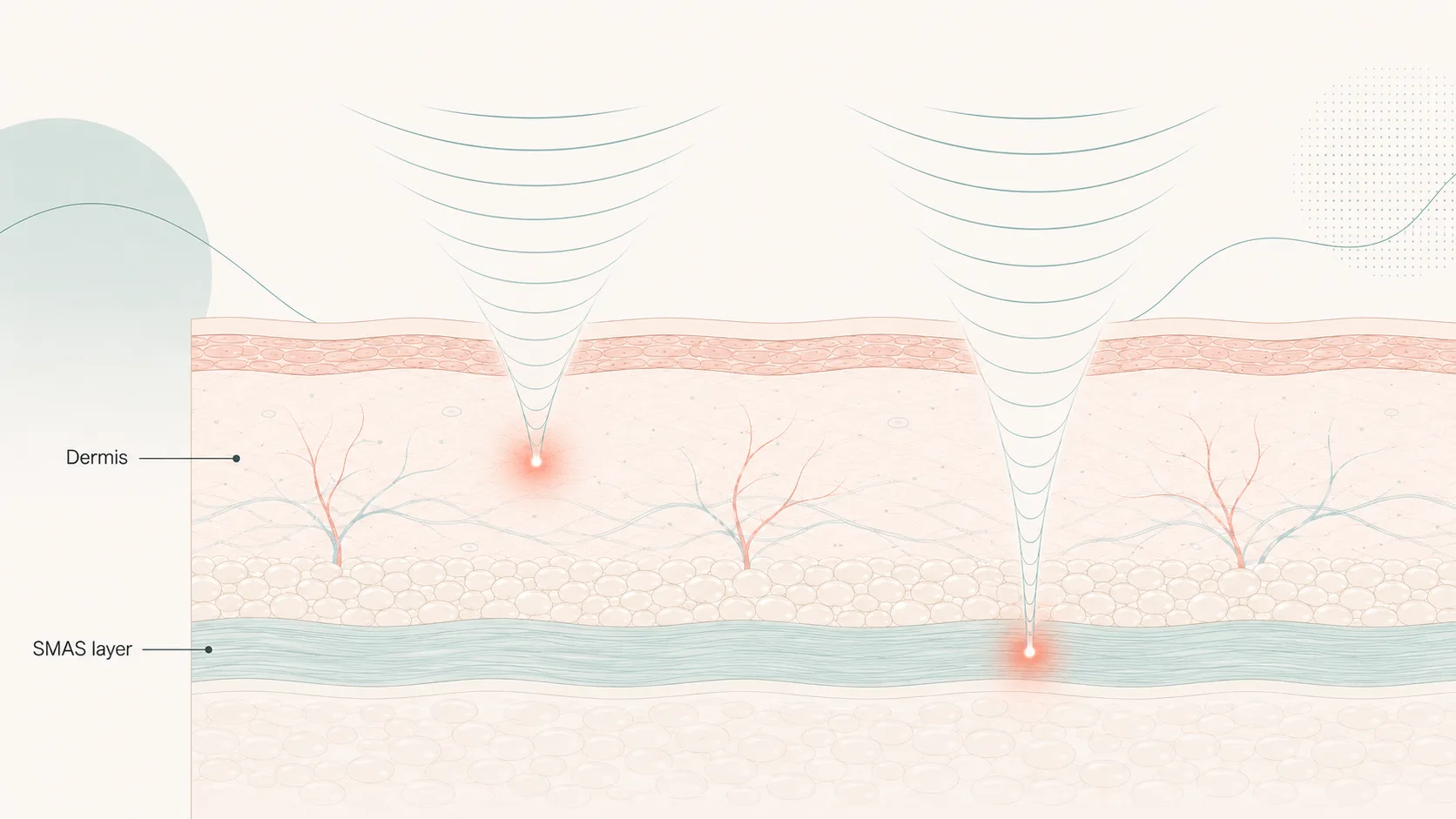
What clinics use it for
HIFU is generally offered for early-to-moderate skin laxity, most often around:
- the lower face and jawline,
- under the chin,
- the brow, and
- the neck.
Some devices and protocols are also used on body areas. What is appropriate for you — including whether any lifting effect is realistic for your degree of laxity — is something to assess with a doctor. Results vary between individuals and are not guaranteed.
How it compares with Ultherapy, Thermage, RF and surgery
These names come up together and are easy to confuse:
- HIFU is the general category of focused-ultrasound treatments, offered by several device brands.
- Ultherapy is a specific brand of ultrasound-based treatment, notable for using ultrasound imaging to visualise the layers being treated.
- Thermage uses radiofrequency (RF) energy rather than ultrasound, heating tissue in a different way.
- RF microneedling combines fine needles with radiofrequency, working at different depths again.
- Surgery (such as a facelift) physically repositions and removes tissue — a different category altogether, with different results, risks, downtime and cost.
All the energy-based options above are non-surgical and work by stimulating the skin rather than cutting it. We do not rank them or claim one is best — which, if any, suits you depends on your skin, your goals, your tolerance for downtime, and a doctor’s assessment. The Singapore Medical Council’s guidelines classify aesthetic procedures by the strength of the clinical evidence behind them, which is helpful context when options are being compared for you. For a shorter comparison, see HIFU vs Ultherapy and Thermage.
What a session involves
Details vary by device and clinic, but a session commonly includes:
- A consultation and assessment of your skin, sometimes with photographs to track change over time.
- Cleansing and marking of the treatment area.
- Application of the device, which delivers energy along lines or in a set number of “shots” across the area.
- A sensation often described as brief heat or a deep prickling at each point; comfort measures vary by clinic and area.
A full-face treatment is frequently a single session with periodic maintenance discussed later, though some plans differ — your doctor will explain what is suggested for you and why.
Downtime and aftercare
This is general information, not advice for your case. Many people report little visible downtime after HIFU and return to normal activities the same day, but responses differ. Temporary redness, mild swelling, tenderness or a tingling feeling in the area are commonly described and usually settle. Your clinician should explain aftercare and what is normal versus what should prompt a call back before you start.
Realistic expectations
Because this is where disappointment usually comes from, it is worth being direct:
- Any effect develops gradually as collagen remodels, typically over a couple of months.
- The result is a degree of firming or lifting for suitable candidates — not the outcome of a surgical lift.
- Effects are not permanent; skin continues to age, and maintenance is often discussed over time.
- Outcomes vary between individuals, and no clinic can promise a specific result.
A clinic that sets careful expectations — including telling you when HIFU is unlikely to do much for your degree of laxity — is doing its job well.
Risks and side effects
HIFU is widely used, but it is still a medical, energy-based procedure and carries risks that depend heavily on operator skill and correct settings:
- Redness, swelling, tenderness or minor bruising in the treated area.
- Temporary altered sensation or numbness, as nerves in the region can be affected.
- Rarely, more significant effects such as burns, or temporary weakness of a facial muscle if energy is misdirected.
- The possibility of little visible change, or the sense that the treatment was not worth it for your case.
This is precisely why the person holding the device matters: appropriate depths, energy levels and knowledge of facial anatomy are what keep treatment both effective and safe.
Who may not be a candidate
Suitability is a medical judgement. People with more advanced skin laxity may be better served by discussing surgical options, and a doctor will also consider factors such as pregnancy, active infection or skin conditions in the area, certain implants or devices, and your overall goals. Sometimes the most useful outcome of a consultation is being told that HIFU is not the right tool for what you want.
How it is regulated in Singapore
Energy-based aesthetic devices are regulated as medical devices by the Health Sciences Authority, and treatment should be performed under a registered medical practitioner in an appropriately licensed clinic. The Singapore Medical Council’s guidelines on aesthetic practices set out how such procedures should be offered, classified by the strength of the evidence behind them.
Before booking, confirm the treating doctor is SMC-registered and the clinic is HCSA-licensed — our how we verify page explains how, and the clinic directory lists licensed clinics factually.
What it costs
HIFU pricing depends on the area treated, the number of lines or shots, the specific device and the clinic, so quotes vary widely. General, indicative ranges are on our price guide, and our guide to how aesthetic pricing works explains how to read a quote and what to check. Treat any figure as rough budgeting only; a real price comes from a clinic after assessing you.
Questions to ask before booking
- Is HIFU realistic for my degree of skin laxity, or would something else suit my goals better?
- Is the treating doctor SMC-registered, and is the clinic HCSA-licensed?
- Which device and protocol will be used, and how many lines or shots for my area?
- What results are realistic for me, over what timeframe, and how long might they last?
- What are the specific risks, and what is the aftercare?
- Is this a single session or a plan, and what is the total expected cost?
Common questions
Is HIFU a non-surgical facelift? It is a non-surgical, energy-based treatment that may firm or lift for suitable candidates, but it is not equivalent to surgery and does not produce the same outcome. Compare options with a doctor.
How soon will I see a change? Any effect develops gradually as collagen remodels, often over a couple of months, rather than immediately.
How long do results last? There is no fixed duration that applies to everyone; effects are temporary and skin keeps ageing, so maintenance is commonly discussed. Ask your doctor what is realistic for you.
Does it hurt? People describe brief heat or deep prickling at each point. Comfort varies by area and clinic — ask what they do to manage it.
How many sessions do I need? It varies. Some plans are a single session with maintenance later; others differ. This is decided with your doctor rather than a set figure.
For the treatment in brief, see the HIFU overview, and for the wider picture of firmness and ageing skin, the skin ageing page.