Pico laser for acne scars in Singapore: what it can and can't do
A neutral guide to picosecond laser for acne scarring: which scar types it may address, how fractional treatment works, risks, and why assessment comes first.
Pico laser is often marketed for acne scars, but whether it helps — and how much — depends almost entirely on the type of scarring you have. This guide explains where picosecond laser realistically fits, what it is less suited to, and why a doctor’s assessment of your scars should come before any device. It is general information for your research only — not medical advice, and not a quote.
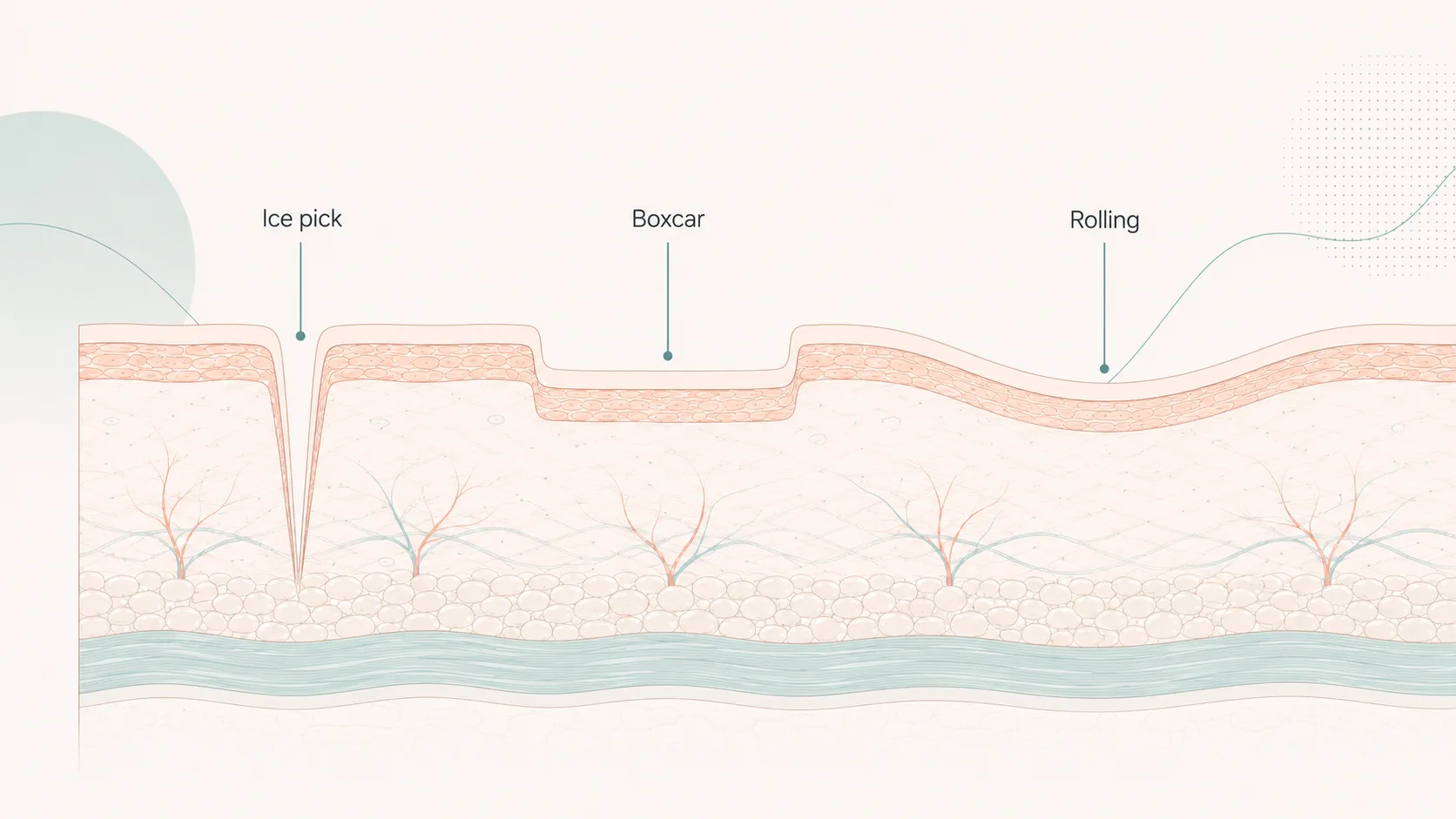
“Acne scars” are not one thing
The single most useful thing to understand is that acne leaves behind several different marks, and they are not all scars:
- Atrophic scars (depressed) — the most common, usually grouped as:
- Ice-pick — narrow, deep, like a small puncture.
- Boxcar — wider, with sharper edges.
- Rolling — broad, shallow, with a wavy, tethered look.
- Raised scars (hypertrophic or keloid) — thickened tissue that sits above the skin.
- Discolouration that is not true scarring — flat brown marks (post-inflammatory hyperpigmentation, PIH) or flat red marks (post-inflammatory erythema, PIE). These often fade with time and sun protection and are treated very differently from a textured scar.
Different marks respond to different approaches, which is why a diagnosis matters more than a device name.
Where pico laser fits
Pico laser can play a role in two ways, depending on the handpiece and settings:
- With a fractional lens, the laser creates tiny, controlled zones of energy within the skin, which is intended to stimulate collagen remodelling and gradually soften shallow atrophic scars and general texture.
- With pigment-targeting settings, it can be one option for the brown discolouration (PIH) that acne can leave behind.
In both cases the effect is gradual and partial — pico is one instrument in a wider toolkit, not a single fix for every scar.
What it is less suited to
Being honest about limits is part of choosing well:
- Deep, narrow ice-pick scars often respond better to techniques such as TCA CROSS or minor procedures than to laser resurfacing alone.
- Tethered rolling scars may first need subcision (releasing the fibrous bands beneath) before any resurfacing helps.
- Raised (hypertrophic or keloid) scars are a different problem again and are managed differently.
None of this ranks the options — it simply means the right tool depends on the scar. A clinic that assesses your scar types and explains what laser will and won’t do is doing the job properly.
Other options a doctor may discuss
Depending on your scars, a doctor might raise subcision, TCA CROSS, fractional ablative lasers (such as CO₂ or erbium), radiofrequency microneedling, microneedling, minor surgical techniques, or fillers for support. Acne-scar treatment is frequently a combination over time rather than a single modality — the plan should be built around your scar types, not the machine a clinic happens to own.
Control active acne first
If acne is still active, treating the scars is usually premature — new breakouts can create new marks, and some resurfacing is inappropriate during active inflammation. Getting the acne itself under control, often with a doctor’s help, generally comes first.
What a course looks like
Scar work with pico is typically a series of sessions spaced weeks apart, with gradual, partial change rather than a single dramatic result. The number of sessions depends on your scar type and skin and is decided with your doctor — outcomes vary between individuals and cannot be promised in advance.
Downtime and aftercare
This is general information, not advice for your case. Fractional settings tend to involve more visible after-effects — redness, mild swelling, a sandpaper-like texture or pinpoint marks for a few days — than lighter pigment settings. Sun protection is important throughout, since sun exposure can worsen pigmentation and undermine results. Your clinician should explain preparation and aftercare before you start.
Risks and side effects
- Post-inflammatory hyperpigmentation — the skin responding with more pigment — is a recognised risk and Asian or darker skin can be more prone to it. Conservative settings and an experienced operator matter.
- Prolonged redness, swelling or crusting, and rarely infection or a new scar.
- Partial or slower improvement than hoped, or the need for more sessions or other techniques.
How it is regulated in Singapore
Aesthetic lasers are regulated as medical devices by the Health Sciences Authority and should be used under a registered medical practitioner in an appropriately licensed clinic. The Singapore Medical Council’s guidelines also classify aesthetic procedures by the strength of the evidence behind them. Before booking, confirm the treating doctor is SMC-registered and the clinic is HCSA-licensed — see how we verify and the clinic directory.
What it costs
Acne-scar treatment is usually priced per session and often runs across several sessions, sometimes combined with other techniques — so the total depends on your plan, not a single per-session figure. General ranges are on our price guide; treat them as rough budgeting only.
Questions to ask before booking
- What scar types do I actually have, and is pico laser suitable for them — or is another technique (or a combination) more appropriate?
- Is the treating doctor SMC-registered and the clinic HCSA-licensed?
- How many sessions are likely, and what is the total expected cost?
- What are the risks for my skin type, and how do you reduce the chance of PIH?
- Should my active acne be treated first?
Common questions
Can pico laser remove acne scars completely? Realistically it softens and improves certain scar types gradually and partially; it does not erase scarring, and deep scars often need other techniques.
Is it better than other acne-scar treatments? It is one option among several, each suited to different scars. The right choice depends on your diagnosis, not on which is “best”.
Does it help the brown marks left by acne? Those flat marks (PIH) are discolouration rather than true scars and are treated differently — sometimes with pigment-targeting settings, sun protection and time. See our pigmentation overview.
How many sessions will I need? It varies with your scars and skin, and is decided with your doctor rather than a fixed number.
For how picosecond laser works in general, see the Pico laser guide and the Pico laser overview.